
My understanding .
In my life , Art plays a very important role . I express my thoughts and emotions by creating .
As you may or may not know , everything is art .
We are all artists of our experience , as we construct in space , a tangible
example inspired by our own experience .
Our canvas is everywhere and anywhere
Our potential is limited by our own will . We have been given many tools , and have many capabilities available,..... if we make the decision or choice to apply them and take action .
Please take a look around where you are at this moment ,
your current experience, and who you are , defined by your actions .
I would request that your "self", observe yourself, and your environment .
What do you see ? <>
Much Love and appreciation for all the artists . >
The project of Love ......... has been created for artists of all kinds .
I will strive to reach my highest potential . I will practice my art with Love . ( artist affirmation )
Now the ball is in your court ...do it ... yeah just do it , ...do it .
-mysterious muse 08
I will now be adding a new blog to the daily agenda .
It will be : Artist of the day ----------> You ? ????????
********<-----------please send me a resume and a Bio to this email address
mysteriousmuse@gmail.com---------------->>>>>>***********
The information posted below is reposted from
http://en.wikipedia.org/wiki/Artrefers to a diverse range of human activities and artifacts, and may be used to cover all or any of
the arts, including
music,
literature and other forms. It is most often used to refer specifically to the
visual arts, including media such as
painting,
sculpture, and
printmaking. However it can also be applied to forms of art that stimulate the other senses, such as
music, an
auditory art.
Aesthetics is the branch of philosophy which considers art.
Traditionally the term art was used to refer to any skill or mastery, a concept which altered during the Romantic period, when art came to be seen as "a special faculty of the human mind to be classified with religion and science".[1] Generally art is a (product of) human activity, made with the intention of stimulating the human senses as well as the human mind; by transmitting emotions and/or ideas. Beyond this description, there is no general agreed-upon definition of art. Art is also able to illustrate abstract thought and its expressions can elicit previously hidden emotions in its audience.
The evaluation of art has become especially problematic since the 20th century. Wollheim distinguishes three approaches: the Realist, whereby aesthetic quality is an absolute value independent of any human view; the Objectivist, whereby it is also an absolute value, but is dependent on general human experience; and the Relativist position, whereby it is not an absolute value, but depends on, and varies with, the human experience of different humans.[2] An object may be characterized by the intentions, or lack thereof, of its creator, regardless of its apparent purpose. A cup, which ostensibly can be used as a container, may be considered art if intended solely as an ornament, while a painting may be deemed craft if mass-produced.
Visual art is defined as the arrangement of colors, forms, or other elements "in a manner that affects the sense of beauty, specifically the production of the beautiful in a graphic or plastic medium".[3] The nature of art has been described by Richard Wollheim as "one of the most elusive of the traditional problems of human culture".[4] It has been defined as a vehicle for the expression or communication of emotions and ideas, a means for exploring and appreciating formal elements for their own sake, and as mimesis or representation.[5] Leo Tolstoy identified art as a use of indirect means to communicate from one person to another.[5] Benedetto Croce and R.G. Collingwood advanced the idealist view that art expresses emotions, and that the work of art therefore essentially exists in the mind of the creator.[6][7] Art as form has its roots in the philosophy of Immanuel Kant, and was developed in the early twentieth century by Roger Fry and Clive Bell.[5] Art as mimesis or representation has deep roots in the philosophy of Aristotle.[5]
The most common usage of the word "art," which rose to prominence after 1750, is understood to denote skill used to produce an aesthetic result.[8] Britannica Online defines it as "the use of skill and imagination in the creation of aesthetic objects, environments, or experiences that can be shared with others."[9] By any of these definitions of the word, artistic works have existed for almost as long as humankind: from early pre-historic art to contemporary art.
Many books and journal articles have been written about the concept of "art".[10] Where Adorno said in 1970 "It is now taken for granted that nothing which concerns art can be taken for granted any more[...],"[11] in 1998, Walt Weaver claimed that "It is self-evident that nothing concerning art is self-evident anymore."[12]
The first and broadest sense of art is the one that has remained closest to the older Latin meaning, which roughly translates to "skill" or "craft," and also from an Indo-European root meaning "arrangement" or "to arrange". In this sense, art is whatever is described as having undergone a deliberate process of arrangement by an agent. A few examples where this meaning proves very broad include artifact, artificial, artifice, artillery, medical arts, and military arts. However, there are many other colloquial uses of the word, all with some relation to its etymology.
The second and more recent sense of the word art is as an abbreviation for creative art or fine art. Fine art means that a skill is being used to express the artist’s creativity, or to engage the audience’s aesthetic sensibilities, or to draw the audience towards consideration of the finer things. Often, if the skill is being used in a common or practical way, people will consider it a craft instead of art. Likewise, if the skill is being used in a commercial or industrial way, it will be considered Commercial art instead of art. On the other hand, crafts and design are sometimes considered applied art. Some art followers have argued that the difference between fine art and applied art has more to do with value judgments made about the art than any clear definitional difference.[13] However, even fine art often has goals beyond pure creativity and self-expression. The purpose of works of art may be to communicate ideas, such as in politically-, spiritually-, or philosophically-motivated art; to create a sense of beauty (see aesthetics); to explore the nature of perception; for pleasure; or to generate strong emotions. The purpose may also be seemingly nonexistent.

Painting by
Song Dynasty artist Ma Lin, c. 1250. 24,8 × 25,2 cm.
The ultimate derivation of fine in fine art comes from the philosophy of Aristotle, who proposed four causes or explanations of a thing. The final cause of a thing is the purpose for its existence, and the term fine art is derived from this notion. If the final cause of an artwork is simply the artwork itself, "art for art's sake", and not a means to another end, then that artwork could appropriately be called fine. The closely related concept of beauty is classically defined as "that which when seen, pleases". Pleasure is the final cause of beauty and thus is not a means to another end, but an end in itself.
Art can describe several things: a study of creative skill, a process of using the creative skill, a product of the creative skill, or the audience’s experience with the creative skill. The creative arts (art as discipline) are a collection of disciplines (arts) that produce artworks (art as objects) that are compelled by a personal drive (art as activity) and echo or reflect a message, mood, or symbolism for the viewer to interpret (art as experience). Artworks can be defined by purposeful, creative interpretations of limitless concepts or ideas in order to communicate something to another person. Artworks can be explicitly made for this purpose or interpreted based on images or objects.
Art is something that stimulates an individual's thoughts, emotions, beliefs, or ideas through the senses. It is also an expression of an idea and it can take many different forms and serve many different purposes.
Although the application of scientific theories to derive a new scientific theory involves skill and results in the "creation" of something new, this represents science only and is not categorized as art.
[edit] Theories
In the nineteenth century, artists were primarily concerned with ideas of truth and beauty: typically the aesthetic theorist John Ruskin, who championed the raw naturalism of J. M. W. Turner, saw art's role as the communication by artifice of an essential truth that could only be found in nature.[14] There was a radical break in the thinking about art in the early twentieth century with the arrival of Modernism, and then in the late twentieth century with the advent of postmodernism. Clement Greenberg's 1960 article "Modernist Painting" defined Modern Art as "the use of characteristic methods of a discipline to criticize the discipline itself".[15]
Greenberg originally applied this idea to the Abstract Expressionist movement and used it as a way to understand and justify flat (non-illusionistic) abstract painting:
Realistic, naturalistic art had dissembled the medium, using art to conceal art; modernism used art to call attention to art. The limitations that constitute the medium of painting – the flat surface, the shape of the support, the properties of the pigment — were treated by the Old Masters as negative factors that could be acknowledged only implicitly or indirectly. Under Modernism these same limitations came to be regarded as positive factors, and were acknowledged openly.[15]
Though only originally intended as a way of understanding a specific set of artists, this definition of Modern Art underlies most of the ideas of art within the various art movements of the 20th century and early 21st century. The art of Marcel Duchamp becomes clear when seen within this context; when submitting a urinal, titled fountain, to the Society of Independent Artists exhibit in 1917 he was critiquing the art exhibition using its own methods.
Andy Warhol became an important artist through critiquing popular culture, as well as the art world, through the language of that popular culture. The later postmodern artists of the 1980s, 1990s, and 2000s took these ideas further by expanding this technique of self-criticism beyond high art to all cultural image-making, including fashion images, comics, billboards and pornography.
[edit] Utility
One of the defining characteristics of fine art as opposed to applied art is the absence of any clear usefulness or utilitarian value. However, this requirement is sometimes criticized as being class prejudice against labor and utility. Opponents of the view that art cannot be useful, argue that all human activity has some utilitarian function, and the objects claimed to be "non-utilitarian" actually have the function of attempting to mystify and codify flawed social hierarchies. It is also sometimes argued that even seemingly non-useful art is not useless, but rather that its use is the effect it has on the psyche of the creator or viewer.
Art is also used by art therapists, psychotherapists and clinical psychologists as art therapy. Art can also be used as a tool of Personality Test. The end product is not the principal goal in this case, but rather a process of healing, through creative acts, is sought. The resultant piece of artwork may also offer insight into the troubles experienced by the subject and may suggest suitable approaches to be used in more conventional forms of psychiatric therapy.
Graffiti art and other types of street art are graphics and images that are spray-painted or stencilled on publicly viewable walls, buildings, buses, trains, and bridges, usually without permission. This type of art is part of various youth cultures, such as the US hip-hop culture. It is used to express political views and depict creative images.
In a social context, art can serve to boost the public's morale. Art is often utilized as a form of propaganda, and thus can be used to subtly influence popular conceptions or mood. In some cases, artworks are appropriated to be used in this manner, without the creator having initially intended the art to be used as propaganda.
From a more anthropological perspective, art is often a way of passing ideas and concepts on to later generations in a (somewhat) universal language. The interpretation of this language depends upon the observer’s perspective and context. So conversely the very subjectivity of art demonstrates its importance in facilitating the exchange and discussion of rival ideas, or to provide a social context in which disparate groups of people might congregate and mingle.
[edit] Classification disputes
-
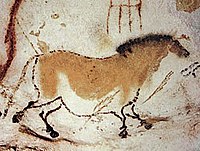
Image of a horse from the
Lascaux caves.
It is common in the history of art for people to dispute whether a particular form or work, or particular piece of work counts as art or not. In fact for much of the past century the idea of art has been to simply challenge what art is. Philosophers of Art call these disputes “classificatory disputes about art.” For example, Ancient Greek philosophers debated about whether or not ethics should be considered the "art of living well". Classificatory disputes in the 20th century included: cubist and impressionist paintings, Duchamp’s Fountain, the movies, superlative imitations of banknotes, propaganda, and even a crucifix immersed in urine. Conceptual art often intentionally pushes the boundaries of what counts as art and a number of recent conceptual artists, such as Damien Hirst and Tracy Emin have produced works about which there are active disputes. Video games and role-playing games are both fields where some recent critics have asserted that they do count as art, and some have asserted that they do not.
Philosopher David Novitz has argued that disagreement about the definition of art are rarely the heart of the problem. Rather, "the passionate concerns and interests that humans vest in their social life" are "so much a part of all classificatory disputes about art" (Novitz, 1996). According to Novitz, classificatory disputes are more often disputes about our values and where we are trying to go with our society than they are about theory proper. For example, when the Daily Mail criticized Hirst's and Emin’s work by arguing "For 1,000 years art has been one of our great civilising forces. Today, pickled sheep and soiled beds threaten to make barbarians of us all" they are not advancing a definition or theory about art, but questioning the value of Hirst’s and Emin’s work.[16] In 1998, Arthur Danto, suggested a thought experiment showing that "the status of an artifact as work of art results from the ideas a culture applies to it, rather than its inherent physical or perceptible qualities. Cultural interpretation (an art theory of some kind) is therefore constitutive of an object’s arthood."[17][18]
[edit] Controversial art
Theodore Gericault's "Raft of the Medusa" (1820), was a social commentary on a current event, unprecedented at the time. Edouard Manet's "Le Déjeuner sur l'Herbe" (1863), was considered scandalous not because of the nude woman, but because she is seated next to fully-dressed men. John Singer Sargent's "Madame Pierre Gautreau (Madam X)" (1884), caused a huge uproar over the reddish pink used to color the woman's ear lobe, considered far too suggestive and supposedly ruining the high-society model's reputation.
In the twentieth century, Pablo Picasso's Guernica (1937) used arresting cubist techniques and stark monochromatic oils, to depict the harrowing consequences of a contemporary bombing of a small, ancient Basque town. Leon Golub's Interrogation III (1981), depicts a female nude, hooded detainee strapped to a chair, her legs open to reveal her sexual organs, surrounded by two tormentors dressed in everyday clothing. Andres Serrano's Piss Christ (1989) is a photograph of a crucifix, sacred to the Christian religion and representing Christ's sacrifice and final suffering, submerged in a glass of the artist's own urine. The resulting uproar led to comments in the United States Senate about public funding of the arts.
In the twenty-first century, Eric Fischl created Tumbling Woman as a memorial to those who jumped or fell to their death in the attacks on the World Trade Center on September 11, 2001. Initially installed at Rockefeller Center in New York City, within a year the work was removed as too disturbing.[19]
[edit] Art, class and value

Versailles:
Louis Le Vau opened up the interior court to create the expansive entrance
cour d'honneur, later copied all over Europe
Art has been perceived by some as belonging to some social classes and often excluding others. In this context, art is seen as an upper-class activity associated with wealth, the ability to purchase art, and the leisure required to pursue or enjoy it. For example, the palaces of Versailles or the Hermitage in St. Petersburg with their vast collections of art, amassed by the fabulously wealthy royalty of Europe exemplify this view. Collecting such art is the preserve of the rich, or of governments and institutions.
Fine and expensive goods have been popular markers of status in many cultures, and continue to be so today. There has been a cultural push in the other direction since at least 1793, when the Louvre, which had been a private palace of the Kings of France, was opened to the public as an art museum during the French Revolution. Most modern public museums and art education programs for children in schools can be traced back to this impulse to have art available to everyone. Museums in the United States tend to be gifts from the very rich to the masses (The Metropolitan Museum of Art in New York City, for example, was created by John Taylor Johnston, a railroad executive whose personal art collection seeded the museum.) But despite all this, at least one of the important functions of art in the 21st century remains as a marker of wealth and social status.

Performance by
Joseph Beuys, 1978 :
Everyone an artist — On the way to the libertarian form of the social organism.
There have been attempts by artists to create art that can not be bought by the wealthy as a status object. One of the prime original motivators of much of the art of the late 1960s and 1970s was to create art that could not be bought and sold. It is "necessary to present something more than mere objects"[20] said the major post war German artist Joseph Beuys. This time period saw the rise of such things as performance art, video art, and conceptual art. The idea was that if the artwork was a performance that would leave nothing behind, or was simply an idea, it could not be bought and sold. "Democratic precepts revolving around the idea that a work of art is a commodity impelled the aesthetic innovation which germinated in the mid-1960s and was reaped throughout the 1970s. Artists broadly identified under the heading of Conceptual art... substituting performance and publishing activities for engagement with both the material and materialistic concerns of painted or sculptural form... [have] endeavored to undermine the art object qua object."[21]
In the decades since, these ideas have been somewhat lost as the art market has learned to sell limited edition DVDs of video works,[22] invitations to exclusive performance art pieces, and the objects left over from conceptual pieces. Many of these performances create works that are only understood by the elite who have been educated as to why an idea or video or piece of apparent garbage may be considered art. The marker of status becomes understanding the work instead of necessarily owning it, and the artwork remains an upper-class activity. "With the widespread use of DVD recording technology in the early 2000s, artists, and the gallery system that derives its profits from the sale of artworks, gained an important means of controlling the sale of video and computer artworks in limited editions to collectors."[23] Another example of this shift is the art of Chris Burden. Chris Burden is most famous for his 1971 performance art piece Shoot in which he had a friend shoot him in the arm with a 22 rifle (and in which nothing was sold). By the late 1980s, in exhibitions and a museum retrospective, he was exhibiting "relics" of early performance art pieces in Plexiglass boxes, including two nails that he used to nail himself to the back of a Volkswagen Beetle in the 1974 artwork Trans-Fixed.[24] By 2003 he was selling the artwork Gold Bullets, 22-carat gold bullets that called to mind his most famous work, in Plexiglass boxes set on a high pedestal at the Gagosian Gallery.[25] This allowed collectors to buy bullets that allude to this important work, that are by this artist, that seem to have other added value in that they are made of gold, and that will be understood as important by others that know the history of conceptual art.
[edit] Forms, genres, mediums, and styles
-
The creative arts are often divided into more specific categories, such as decorative arts, plastic arts, performing arts, or literature. So for example painting is a form of visual art, and poetry is a form of literature.
An art form is a specific form for artistic expression to take, it is a more specific term than art in general, but less specific than genre.
Some examples include, but are by no means limited to:
An artistic medium is the substance the artistic work is made out of. So for example, stone and bronze are both mediums that sculpture uses sometimes. Multiple forms can share a medium (poetry and music, both use sound), or one form can use multiple media.
A genre is a set of conventions and styles within an art form and media. For instance, well recognized genres in film, for example, are western, horror and romantic comedy. Genres in music include death metal and trip hop. Genres in painting include still life, and pastorial landscape. A particular work of art may bend or combine genre but each genre has a recognizable group of conventions, clichés and troupes. (One note: the word genre has a second older meaning within painting, genre painting was a phrase used in the 17th to 19th century to refer specifically to paintings of scenes of everyday life and can still be used in this way.)
An artwork, artist’s, or movements style is the distinctive method and form that art takes. Any loose brushy, dripped or poured abstract painting is called expressionistic (with a lower case "e" and the "ic" at the end). Often these styles are linked with a particular historical period, set of ideas, and particular artistic movement. So Jackson Pollock is called an Abstract Expressionist. Because a particular style has very specific cultural meanings it is important to be sensitive to differences in technique. Roy Lichtenstein's paintings are not pointillist, despite his uses of dots, because they are not aligned with the original proponents of Pointillism. Lichtenstein used Ben-Day dots: they are evenly-spaced and create flat areas of color. These types of dots were used to color comic strips and are intended to combine the "high" art of painting with the "low" art of comics - to comment on culture and its unreality. Pointillism employs dots that are spaced in a way to create variation in color and depth - it was an attempt to paint images that were closer to the way we really see color - an attempt to get closer to reality. They both use dots but the meaning is opposite.
These are all ways of beginning to define a work of art, to narrow it down. "Imagine you are an art critic whose mission is to compare the meanings you find in a wide range of individual artworks. How would you proceed with your task? One way to begin is to examine the materials each artist selected in making an object, image video, or event. The decision to cast a sculpture in bronze, for instance, inevitably effects its meaning; the work becomes something different than if it had been cast in gold or plastic or chocolate, even if everything else about the artwork remained the same. Next, you might examine how the materials in each artwork have become an arrangement of shapes, colors, textures, and lines. These, in turn, are organized into various patterns and compositional structures. In your interpretation, you would comment on how salient features of the form contribute to the overall meaning of the finished artwork. [But in the end] the meaning of most artworks... is not exhausted by a discussion of materials, techniques, and form. Most interpretations also include a discussion of the ideas and feelings the artwork engenders."[26]


